

Introduction
If you’re flying to or from Europe this week, four moving parts are worth knowing about. The EES system is still slowing the main European hubs. Memorial Day weekend is adding record U.S. traffic to the mix. Several global events are saturating specific airports. And last week closed with cancellation numbers that are hard to ignore.
This is the second consecutive week where European aviation has been running at full capacity with almost no buffer, and now the U.S. side is about to join the party. The EES system, the EU’s new Entry/Exit System for non-EU travelers, was fully rolled out on April 10. One month in, processing times and queues remain the main friction point. Layer on top of that the Cannes Film Festival, IMEX Frankfurt, and the start of the U.S. Memorial Day rush, and the picture for the days ahead becomes clear.
Here’s where things stand.
The EES System One Month After Full Rollout
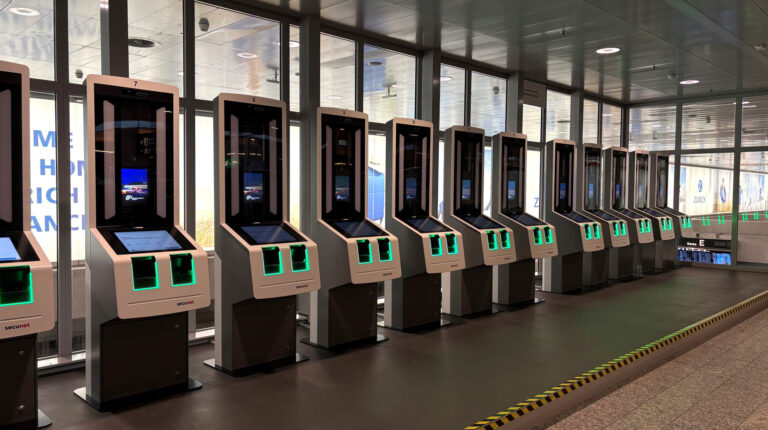
The EES system is now active across all 29 participating Schengen countries. According to the European Commission, the launch was successful and processing times have improved as border officers gain experience with the new biometric checks. Airport operators see it differently.
ACI Europe (Airports Council International) reported that border processing times rose by 70% after the full rollout. Waits of two to three hours at peak periods have become standard at the busiest hubs, and on some days, four-hour queues have been recorded.
On May 2, the European Commission moved to ease border pressure by allowing member states to apply flexible implementation of the EES system. Spokesperson Markus Lammert clarified that this is not a suspension but a practical adjustment. Countries can temporarily pause time-intensive steps like biometric registration during peak hours. The flexibility window runs for 90 days after the April 10 rollout, with a possible 60-day extension, meaning border authorities can use it through early September.
For travelers, the takeaway is simple: the EES system isn’t going away, but enforcement varies country by country and hour by hour. Border officers in Greece and Portugal have been more willing to scale back checks during congestion. France, Germany, and the Netherlands have been stricter so far.
If you’re entering the Schengen Area for the first time since April 10, you’ll need to provide fingerprints and a facial image. That data is stored for three years, so future trips move faster. Children under 12 are exempt from fingerprints but still need a photo.
Last Week’s Delays and Cancellations: The Real Numbers
Last week was one of the most disrupted in European aviation so far this year. Data compiled from FlightAware and reported by Travel and Tour World and other industry trackers shows the scale:
- May 10: 2,233 flight delays and 56 cancellations across Europe. Palma de Mallorca led with 401 delays, followed by Madrid with 330. Ryanair and Lufthansa each recorded close to 170 delays.
- May 12: A national strike in Belgium shut down Brussels South Charleroi entirely and forced 325 cancellations at Brussels Airport. Across Europe that day: 230 cancellations and 1,284 delays.
- May 13: 2,296 delays and 87 cancellations. Heathrow, Frankfurt, Amsterdam, Athens, Madrid, and Paris CDG all in the top-affected list.
- May 14: 1,939 disruptions. British Airways alone had 76 cancellations and 454 delays at Heathrow.
- May 16–17: Between 1,400 and 1,500 delays per day. Heathrow stayed at the top of the list, with Schiphol close behind.
Multiple factors are stacking up. The EES system is adding processing time at borders. ATC staffing shortages have not been fully addressed. Strikes in Belgium and Italy keep rotating through the calendar. British Airways’ IT issues haven’t been resolved. And spring tourism is filling planes to capacity.
When one flight runs late, crew rotations compress and downstream departures slip. A morning delay at Heathrow now affects connections in Helsinki by afternoon.
Memorial Day Weekend Adds U.S. Pressure to the Mix
This week also marks Memorial Day weekend in the United States, running Thursday, May 21 through Monday, May 25. AAA forecasts that 45 million Americans will travel at least 50 miles from home over the long weekend, a new all-time record. Of those, 3.66 million are expected to fly, with 39.1 million driving and another 2.2 million using buses, trains, or cruises.
The aviation share matters here for two reasons.
First, U.S. hubs will run hot. Orlando tops the list of Memorial Day destinations, with Miami, Fort Lauderdale, and Tampa all sitting in the AAA top-10. If you’re connecting through MIA or FLL this weekend, expect TSA lines to peak Thursday afternoon and Friday morning. Sunday is forecast to be the lightest day for both road and air travel.
Second, transatlantic flights are part of the surge. A meaningful share of Memorial Day flyers is heading to Europe over the long weekend, and they arrive at the same EES system checkpoints described above. Heathrow, Paris CDG, Rome Fiumicino, and Madrid will see an extra wave of first-time EES system registrations on Friday May 22 and Saturday May 23 as the U.S. holiday traffic lands.
REAL ID enforcement, which began on May 7, is also worth flagging. Travelers who show up at U.S. checkpoints without a compliant ID will be redirected to TSA’s new ConfirmID alternative verification process. It works, but it slows you down. Make sure your ID is REAL ID-compliant before heading to the airport.
If your itinerary involves both a U.S. domestic leg and a European arrival in the same week, plan accordingly on both ends.
Global Events Shaping Air Traffic in Europe This Week
Beyond Memorial Day, several major events are concentrating travelers at specific European airports between May 18 and 24.
Cannes Film Festival (May 12–23) is in its final stretch, and Nice Côte d’Azur Airport (NCE) is feeling it. Industry reports estimate more than 750 charter flights during the three-week window, with private jets blocking commercial slots. Travelers flying through Nice this week should expect ground transport bottlenecks and longer taxi times.
IMEX Frankfurt (May 19–21) is one of the largest MICE trade shows in the world. Tens of thousands of buyers and exhibitors are arriving in Frankfurt this week, an airport already among the most disrupted in Europe.
IPW 2026 in Fort Lauderdale (May 17–21), organized by the U.S. Travel Association, brings more than 6,000 international travel buyers, suppliers, and media. Combined with Memorial Day departures, MIA and FLL will see compounded pressure.
4th IAGTO European Convention (May 18–20, Malaga) brings golf tourism operators from across Europe to Málaga–Costa del Sol Airport, where business arrivals layer on top of leisure traffic.
On top of all this, Cannes wraps up on May 23, the same weekend Monaco begins setup for the Grand Prix (race weekend June 5–7). Nice will not catch a break.
Which Hubs Are Most Affected Right Now
Based on disruption data from the past seven days, these are the airports where travelers should plan extra buffer this week:
London Heathrow (LHR): The most disrupted hub in Europe. British Airways’ IT problems and US-to-UK transatlantic schedule density are creating cascading delays. Most weekdays are seeing 300+ delays.
Amsterdam Schiphol (AMS): Consistently second in the disruption rankings. Capacity is at the ceiling and ground handling friction has not eased.
Paris Charles de Gaulle (CDG): Catching the ripple effect of Cannes-related private aviation plus EES processing time at non-Schengen arrivals.
Frankfurt (FRA): IMEX Frankfurt is arriving on top of an already strained Lufthansa operation.
Nice (NCE): Saturated through May 23. Cannes-related private jet volume is the dominant factor.
Madrid-Barajas (MAD) and Palma de Mallorca (PMI): Spring tourism plus Memorial Day inbound traffic from the U.S. are filling Spanish hubs to capacity.
Miami International (MIA) and Fort Lauderdale (FLL): Memorial Day plus IPW will push Florida hubs to peak volumes Thursday May 21 through Monday May 25.
If your itinerary touches any of these, build margin.
Smart Moves for Travelers This Week
A few practical things that make a real difference:
Arrive earlier than the airline’s standard recommendation. For Heathrow, Frankfurt, Madrid, and Palma, 3.5 hours before departure is reasonable right now. For MIA and FLL on Memorial Day weekend, plan for the same. For Nice, factor in road traffic and longer drop-off times around the Croisette.
Confirm your ID is REAL ID-compliant. If you’re flying domestically in the U.S. and your driver’s license doesn’t have the star marker, bring a passport instead. ConfirmID is available but adds time.
Pre-register on the Travel to Europe app where available. The EU’s official EES system app lets third-country travelers submit biometric data 72 hours before arrival in Portugal and Sweden, with more countries being added. It doesn’t replace the border interview, but it shortens the kiosk step.
Know your rights under EU261/2004. If your delay is the airline’s fault and runs past two hours, you’re entitled to meals, communication, and, in some cases, hotel accommodation. Compensation can range from €250 to €600 depending on flight distance.
Rebook through the airline app, not the desk. When a flight is cancelled, the app is almost always faster than the queue.
Avoid Sunday peak return traffic. AAA flags Sunday May 25 afternoon as a heavy traffic period nationally. If you can fly back Saturday or Monday morning instead, you’ll move faster.
How Royal Airport Concierge Helps With the EES System and Holiday Crowds
The EES system is part of EU immigration. No private service can bypass it. What we can do is make the process easier and faster for you, in Europe and in the U.S.
When you land at one of the 50+ European airports where Royal Airport Concierge operates, a uniformed greeter meets you at the aircraft door or jet bridge. From there, you’re walked directly to the correct biometric kiosk or staffed booth, with no wrong queues and no signage confusion. The greeter handles documentation guidance, coordinates luggage, and stays with you until you’re at your ground transport.
For first-time EES system registrations, this matters most. The initial biometric capture is the longest step, and being routed efficiently through it saves real time during peak hours.
On the U.S. side, our greeters at Miami, Fort Lauderdale, JFK, LAX, and other major hubs handle the Memorial Day crowds the same way: meeting you curbside, walking you through TSA priority lanes where applicable, and keeping the airport part of your trip short and predictable.
If you’re flying this Memorial Day weekend or in the weeks ahead and want a calmer arrival or departure, book your meet and greet with Royal Airport Concierge. Our team handles the airport details so you can step off the plane and into your trip without losing hours at the border or the checkpoint.

 English
  Español
  Français
  简体中文
简体中文  Русский
  Italiano
  العربية