


EES Entry/Exit System
Seamless European Arrivals and Departures
EES Airport Assistance in Europe
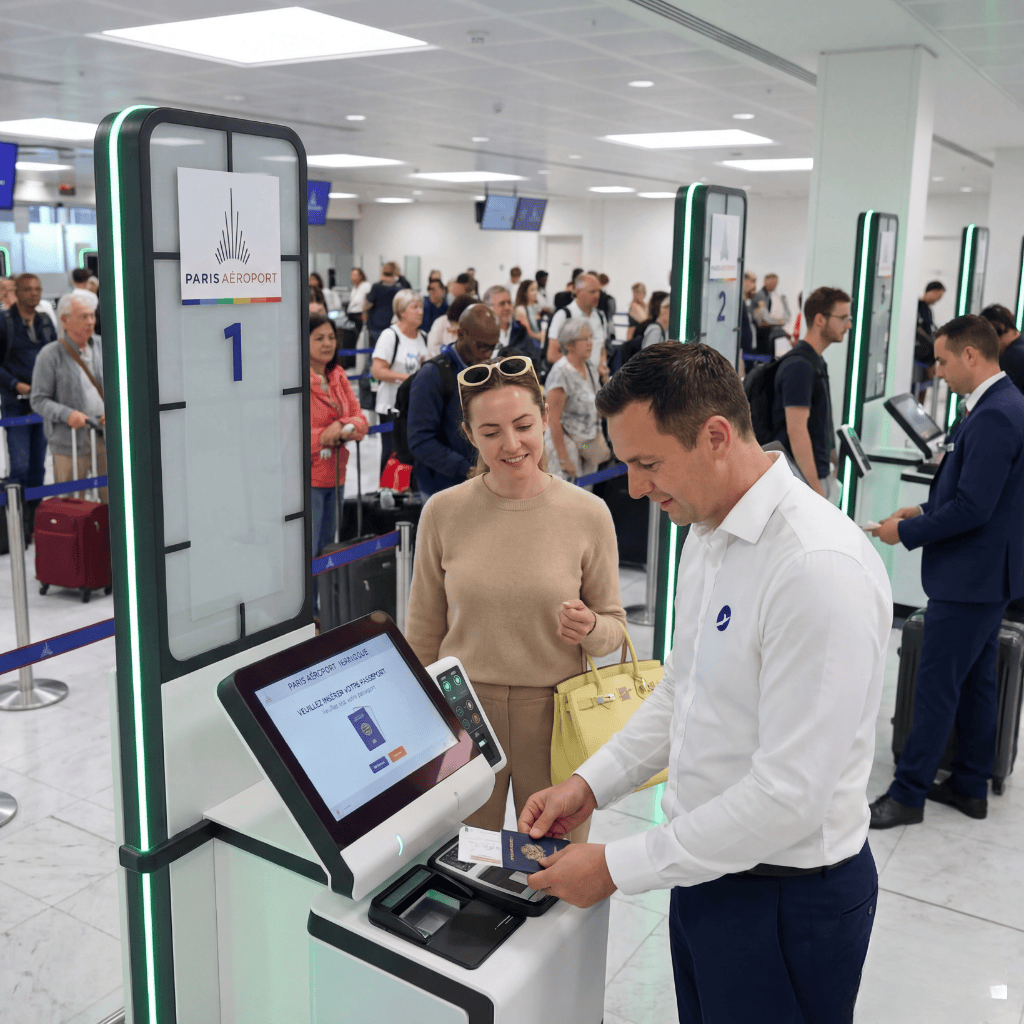
Don’t Let the New EES Protocols Slow Your Journey. The EU Entry/Exit System (EES) adds biometric border checks for non-EU travelers, and first-time registration can take extra time. Our Meet and Greet service gives you a greeter who guides you through each step. Fast Track is available at selected airports.
Europe Changed Its Border Checks. We Guide You Through Them.
Since April 10, 2026, every non-EU traveler on a short stay is registered digitally when entering and leaving the Schengen Area. For frequent travelers, executives and families, that can mean longer waits at major hubs. With our Meet and Greet service, a greeter meets you on arrival and stays with you until you reach your vehicle.
How the EES Works at the Airport
Fast Track and priority access are subject to local airport security regulations and availability per location.
How We Help You Through the EES
The EES brings new biometric steps to European border control. Our greeters know the process at each airport and stay with you from the aircraft to your vehicle. Where Fast Track is available, we use it.
Your greeter explains the registration process when they meet you, so you know what to expect before you reach the checkpoint.
At selected European airports we use Fast Track lanes. At all other airports, your greeter guides you along the most efficient route through the terminal.
From the aircraft to your waiting vehicle, your greeter stays with you and helps with your luggage.
Experience a Smooth Arrival in EES Entry Exit System
The Royal Airport Concierge Advantage: Your greeter guides you directly to the most efficient lanes available or fast-track kiosks (where available) and provides hands-on airport assistance with the digital interface to ensure zero technical errors or delays.

The Royal Airport Concierge Advantage: We remove the administrative burden. Your greeter ensures all your travel documentation (invitations, hotel confirmations) is pre-organized and readily accessible, turning a stressful interrogation into a swift, effortless process.

The Royal Airport Concierge Advantage: We guide you through the final border check. Your greeter communicates with the officers, translates when necessary, and walks you seamlessly from the checkpoint directly to your waiting vehicle.

Important Details
EES Service by Airport
The EES is mandatory for non-EU travelers on short stays. The support we provide depends on your arrival airport.
Where Fast Track lanes are not available, including Rome Fiumicino (FCO) and Milan Malpensa (MXP), your greeter escorts you through the terminal along the most efficient route. You may still need to wait at border control.
Don't Let EES Delays Define Your Journey. Book EES Airport Assistance
Book Your EES Entry Exit System Arrivals Service
From Paris Charles de Gaulle to Amsterdam Schiphol and airports across Europe, our local teams are ready to meet you. Short-notice availability is limited, so we recommend booking early.
EES Frequently Asked Questions
The EES is the European Union’s digital border system. It replaces passport stamps with a digital record of each entry and exit for non-EU travelers on short stays. It has been fully operational at all external borders of the 29 participating European countries since April 10, 2026.
All non-EU and non-Schengen nationals visiting for a short stay of up to 90 days within a 180-day period, whether or not they need a visa. This includes travelers from the United States, the United Kingdom and Canada. EU citizens and nationals of Iceland, Liechtenstein, Norway and Switzerland are not registered, and holders of residence permits or long-stay visas are generally exempt.
Your passport is scanned and your biometric data is recorded. Visa-exempt travelers provide four fingerprints and a facial image. Travelers who hold a short-stay visa provide only a facial image. If registration at a self-service kiosk does not work, a border officer completes it at a staffed desk.
No. There is nothing to do before traveling. Registration happens at the border and is free.
Yes. Every traveler is registered individually, including infants, and each child needs their own passport. Fingerprints are not taken from children under 12, but a facial image is recorded.
Your record is kept for three years after your last border crossing. During that time, later trips only require a quick fingerprint or photo check against your stored data.
Yes. The system registers travelers each time they enter or exit the external borders of the Schengen Area. Allow extra time at departure as well as on arrival. (Link interno a Departures.)
No. The EES is a border record. ETIAS is a separate travel authorization, similar to the US ESTA, that visa-exempt travelers will apply for online before their trip. The EU plans to introduce it toward the end of 2026, but the date is not confirmed and applications are not open yet. (Esta respuesta es time-sensitive: hay que revisarla cada mes.)
Questions About Our EES Service
The EES is the European Union’s digital border system. It replaces passport stamps with a digital record of each entry and exit for non-EU travelers on short stays. It has been fully operational at all external borders of the 29 participating European countries since April 10, 2026.
At selected airports only: [lista actual: CDG, AMS, BCN, MAD, ORY, FRA, NCE, MUC, HAM, CPH, ARN, ATH]. Fast Track is subject to local airport rules and availability. At all other airports, the service is Meet and Greet with escort through the terminal.
You may. Border checks are run by local authorities and wait times vary by airport and time of day. Where Fast Track is available we use it, and everywhere else your greeter guides you along the most efficient route.
As early as possible. Short-notice availability (24 to 48 hours) is limited, and your booking is confirmed once a greeter is assigned.
 English
 Español
 Français
 简体中文
 Русский
 Italiano
 العربية