

If there is one phrase that immediately spikes the heart rate of even the most seasoned global traveler, it is flight delays. At the beginning of this first week of March 2026, the aviation industry is facing the effects of geopolitical events, massive cultural migrations, and overlapping international conferences. The global airspace map is currently a complex web of reroutes and bottlenecks. For frequent flyers, executives, and families embarking on their spring journeys, understanding these shifting dynamics is no longer just about staying informed—it is the key to maintaining your sanity at the terminal.
Whether you are navigating the sudden logistical hurdles in the Middle East or trying to bypass the Spring Break crowds in the Americas, here is your comprehensive, insider’s look at the current state of air travel, the reasons behind the recent surge in flight delays, and how the industry is adapting.
What’s causing Flight Delays: The Middle East Airspace Crisis and the Global Domino Effect
Undoubtedly, the most significant story impacting global aviation this year is the sudden and severe disruption across the Middle East. Following the unprecedented events of February 28 and March 1, the aviation sector has been forced into a rapid, large-scale logistical pivot.
The Closure of Strategic Hubs
The airspace above Iran, Israel, Iraq, Jordan, and the United Arab Emirates has experienced partial to total closures. The immediate consequence has been the mass suspension of operations at some of the world’s busiest and most luxurious transit hubs, including Dubai (DXB), Abu Dhabi (AUH), and Doha (DOH). Major carriers like Emirates and Etihad have been forced to cancel hundreds of flights over the past 48 hours, leaving thousands of international passengers temporarily stranded.
The Ripple Effect on Global Routes
The Middle East serves as the undisputed “crossroads of the world,” acting as the primary artery connecting Europe to Asia and Oceania. With this artery temporarily clamped, the industry is experiencing a massive domino effect. Airlines are being forced to divert flights through alternative, less direct routes—primarily over Saudi Arabia or the Mediterranean Sea.
These diversions are heavily impacting schedules, drastically increasing both flight times and fuel consumption. Consequently, secondary hubs in Europe and Asia are now dealing with cascading flight delays as they try to accommodate off-schedule arrivals and departures.
Navigating the Disruption
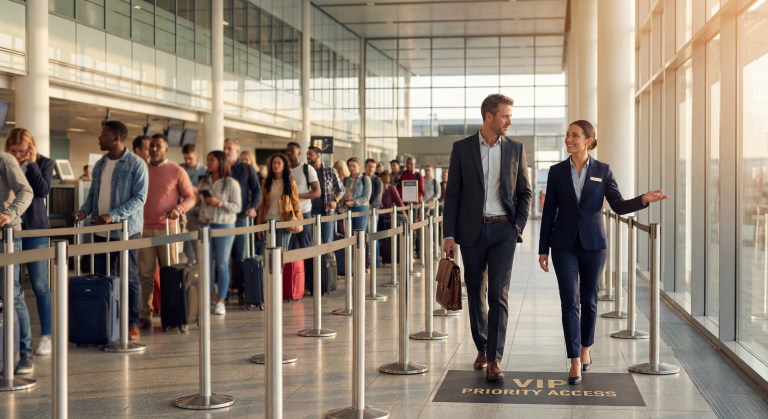
When a crisis of this magnitude hits, the standard airline apology does very little to comfort a stranded traveler. High-level travelers and VIPs don’t want explanations; they require immediate, actionable solutions. This is precisely the environment where elite disruption management becomes invaluable. Navigating these unprecedented flight delays requires aggressive re-routing strategies, securing immediate access to private VIP lounges away from the chaotic main terminals, and dedicated luggage management to ensure bags aren’t lost in the diversion shuffle. Having a dedicated team like Royal Airport Concierge monitoring your journey can mean the difference between a ruined week and a
March 2026: A Collision of Global Events
Beyond the geopolitical hurdles, March is historically a heavy travel month. This year, however, a unique calendar alignment is creating concentrated pockets of extreme congestion. Anticipating these bottlenecks is crucial for anyone taking to the skies this month.
Mobile World Congress (Barcelona, Spain)
The MWC, which gathered the elite of the global tech industry, officially concluded on March 2. Right now, El Prat Airport (BCN) is seeing a massive exodus of executives. Unfortunately, this departure wave coincides directly with the Middle East airspace crisis. Tech leaders attempting to return to Asian markets are facing significant, unavoidable flight delays and last-minute reroutes. Fast-tracking through BCN is highly recommended this week to mitigate the friction.
The Holy Month of Ramadan (Beginning ~March 10)
Starting in the second week of March, Ramadan initiates one of the largest seasonal travel movements in the Islamic world. Expect a massive surge in both family travel and pilgrimage flights. Despite the broader regional tensions, airports serving the Kingdom of Saudi Arabia—particularly King Abdulaziz International in Jeddah (JED) and King Khalid International in Riyadh (RUH)—will operate at peak capacity. For those traveling through these hubs, pre-arranging personalized meet-and-greet services and comfort-focused airport assistance will be essential to bypass the overwhelming crowds.
The Spring Break Rush (United States & Caribbean)
Throughout the entirety of March, North America experiences the annual phenomenon of Spring Break. Leisure destinations are bracing for impact. Airports such as Miami (MIA), Cancun (CUN), and Nassau (NAS) will be stretched to their absolute maximum capacities. The sheer volume of leisure travelers often leads to ground stops and cascading flight delays. For families traveling during this period, the goal is a “stress-free arrival.” Utilizing private transfers and expedited customs lines transforms a historically chaotic experience into a smooth start to a vacation.
World Cargo Symposium (Lima, Peru: March 10-12)
While passenger travel grabs the headlines, the logistics elite will be converging in South America for the WCS. Jorge Chávez International Airport (LIM) in Lima will see a sharp spike in high-level corporate traffic. Executives attending the symposium will benefit greatly from seamless tarmac-to-city transfers to maximize their time on the ground.
F1 Saudi Arabian Grand Prix (Jeddah, Saudi Arabia)
The global motorsport circus arrives in Jeddah this month, bringing with it an Ultra-High-Net-Worth (UHNW) audience. The demand for private aviation terminals (FBOs), luxury ground transportation, and elite VIP airport concierge services will outstrip supply. For this demographic, avoiding standard commercial flight delays and terminal wait times is strictly mandatory.
Silver Linings: Industry Trends and Tech Innovations
While the headlines might seem dominated by congestion and reroutes, the aviation industry is quietly rolling out solutions designed to make the passenger experience smoother and more intuitive.
Biometrics Become the Standard
If there is an antidote to the frustration of flight delays, it is the speed of new technology. Starting this month, a sweeping number of major airports across Europe and the United States are officially phasing out the physical passport at the boarding gate. Comprehensive facial recognition technology is becoming the new standard. This biometric integration allows passengers to move from security to their aircraft seat with unprecedented speed, removing one of the most tedious bottlenecks in the airport ecosystem.
The Rise of the “Quietcation”
A fascinating trend emerging in luxury travel this year is the “Quietcation.” After years of high-intensity tourism, high-end travelers are increasingly seeking out remote, disconnected destinations purely for tranquility and digital detoxing.
However, a “Quietcation” is entirely defeated if the journey there is filled with the stress of terminal crowds and grueling flight delays. The tranquility must begin the moment the traveler steps out of their vehicle at the departure curb. This shift in traveler mindset perfectly aligns with the core philosophy of a premium airport concierge: acting as the serene, invisible shield that absorbs the friction of modern travel, allowing the passenger’s vacation peace to begin before they even board the aircraft.
Moving Forward with Confidence
The landscape of global aviation in March 2026 is undoubtedly complex. Between shifting air corridors, massive tech conferences, cultural holidays, and the Spring Break rush, the potential for severe flight delays is higher than average. Yet, with the right anticipation, the right technology, and the right support network on the ground, the modern traveler can glide through the chaos completely undisturbed. If you are looking to avoid chaos and a streessful airport journey, contact our team to book your airport meet and greet service.
 Español
  English
  Français
  简体中文
简体中文  Русский
  Italiano
  العربية