

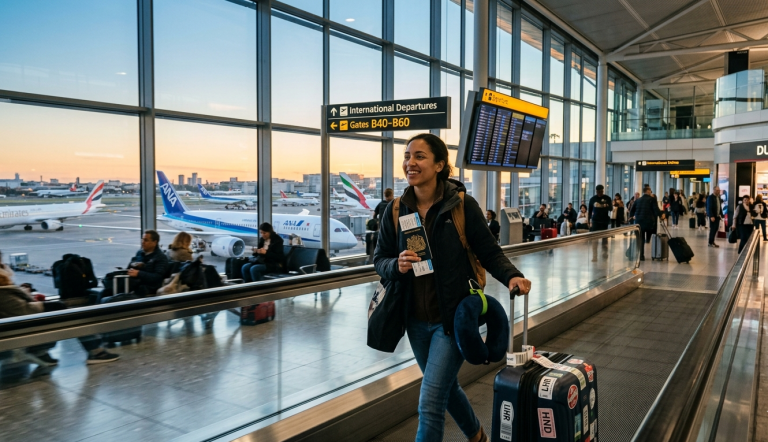
Understanding International Travel Challenges in May 2026
Look, if you thought a business-class ticket was your golden ticket to a smooth trip, I’ve got news for you. In 2026, the real problems aren’t happening at 35,000 feet—they’re on the ground. Packed terminals, weird new biometric systems, and airports that seem like they were designed for about half the people actually trying to use them.
If you’re flying internationally this May—whether from the US, Canada, Europe, or anywhere else—you need to know what’s actually going on right now. Because there’s a lot of weird stuff happening simultaneously that directly impacts your travel plans.
The convergence of new European border regulations, airline capacity reductions, and major global events means that international travel in May 2026 requires more planning and flexibility than ever before.
Europe's New EES System: What It Means for International Travelers
On April 10, 2026, Europe fundamentally changed how travelers enter the Schengen Area. Welcome to the Entry/Exit System (EES): the new biometric border control that replaces traditional passport stamps.
What Is the EES?
The EES is Europe’s new automated entry and exit registration system for non-EU travelers. If you’re coming from the United States, Canada, United Kingdom, or any other non-EU country, you now register biometrically upon your first entry to the Schengen zone—no exceptions.
What happens during EES registration:
- Facial recognition scan
- Fingerprint capture
- Digital data storage in EU systems
- Processing time: 5-15 minutes per traveler
EES Impact on Major European Airports
The rollout has created significant delays at Europe’s busiest international gateways:
Paris-Charles de Gaulle (CDG) – Increased wait times at e-gates, biometric processing delays during peak hours. CDG is one of Europe’s largest international aviation hubs.
Lisbon Airport (LIS) – New biometric gates showing technical issues; staff learning curves causing queue buildup during international arrival waves.
Francfort (FRA) – Gateway to Central Europe, experiencing congestion as travelers navigate new biometric requirements before connecting flights.
Amsterdam (AMS) – Schiphol Airport reporting longer processing times for US and international travelers during morning and evening waves.
London Stansted and Gatwick – UK airports seeing increased transit times as UK citizens navigate their own border changes while European connectivity shifts.
Critical Insight: Recalculate Your Connection Times in Europe
This is the most important thing to know: A comfortable 90-minute layover in Paris or Frankfurt in 2025? That’s no longer safe in 2026.
New minimum connection times for first-time Schengen entrants:
- Previous standard: 90 minutes
- New EES requirement: 2.5 to 3 hours minimum
If you’re booking a connection through any Schengen airport (Paris, Frankfurt, Amsterdam, Munich, Zurich) and it’s your first time entering the EU, you must build in extra time for biometric processing.
Global Airline Capacity Crisis: 2 Million Seats Removed in May 2026
Here’s where international travel gets really disrupted: Approximately 2 million seats have been removed from global airline schedules for May 2026 alone.
Why? Aviation fuel prices are at historically high levels due to geopolitical tensions, and airlines worldwide are making dramatic operational cuts.
Europe's Capacity Cuts
Lufthansa Group (LH, Austrian, SWISS, Brussels Airlines):
- 20,000 flights canceled from May through October 2026
- Focus on fuel efficiency and route optimization
- Direct impact on daily frequencies between European cities
- Affects transatlantic connections from Frankfurt, Munich, Zurich
Air France-KLM Group:
- Reduced frequencies on secondary European routes
- Paris (CDG) and Amsterdam (AMS) still operating major routes but with reduced backup flights
British Airways and IAG:
- Capacity reductions on European-domestic and short-haul routes
- Long-haul transatlantic services maintained but fewer alternative flight options
North America's Capacity Reductions
Air Canada:
- Temporary suspensions on dense corporate routes
- Suspended services on Montreal (YUL) to New York (JFK) routes starting early June
- Toronto (YYZ) to JFK connections facing reduced frequency
United and American Airlines:
- Selective route suspensions focusing on fuel efficiency
- Reduced daily frequencies on traditionally busy corridors
- Miami (MIA), Atlanta (ATL), and New York (JFK, EWR) affected with reduced options
What This Means for International Business Travel
When you’re booking international flights in May 2026, flexibility is gone. If you miss your connection in Frankfurt or Munich:
- Probability of rebooking on the next flight: Minimal
- Aircraft load factors: Averaging 95-100%
- Standby upgrade availability: Almost non-existent
- Recovery time if delayed: Could be 24+ hours
This fundamentally changes how corporations should approach international travel risk management in 2026.
US Airport Chaos: The Spirit Airlines Collapse Impact
On May 2, 2026, Spirit Airlines ceased operations. While this affected one carrier, the systemic impact on US airport infrastructure was devastating.
Immediate Impact: May 2, 2026
Single-day statistics:
- 556 flights canceled
- 3,199 accumulated delays across US airports
- Thousands of stranded passengers
- Terminal capacity exceeded by 40%+ in major hubs
Ongoing Impact on Major US Airports
New York Area (JFK, LaGuardia, Newark/EWR):
- Terminal congestion continues in May
- TSA security checkpoint wait times: 45-90 minutes during peak hours
- Vehicular access roads overwhelmed
- International passenger flow severely impacted
Atlanta Hartsfield-Jackson (ATL):
- US’s busiest airport, now operating at emergency capacity
- Connection delays affecting international flights to Europe and beyond
- Estimated average delay for connections: 30-45 minutes additional buffer needed
Miami International (MIA):
- Major Latin America and Caribbean hub
- Public area congestion affecting international departure processes
- Increased security screening times
Chicago O’Hare (ORD):
- Midwest’s primary international hub
- Increased congestion on transatlantic and transpacific routes
- Connection reliability reduced
Critical Point: Even Direct Flight Passengers Are Affected
The key insight: You don’t have to be flying Spirit Airlines to be impacted. Even if you’re booked on a major carrier flying a transatlantic or transpacific route, you still have to navigate through these overwhelmed US terminals. Domestic infrastructure chaos directly becomes your international travel problem.
For international travelers connecting through US hubs:
- Add 45-60 minutes to your standard connection time
- Expect longer security lines
- Plan for TSA PreCheck or CLEAR membership
- Consider arriving at airport 3.5+ hours before international departure
Middle East Airspace Restrictions: Route Closures and Detours
Direct Route Suspensions
For safety reasons, multiple flight corridors through the Middle East and Western Asia have been restricted or suspended, fundamentally altering major international routes.
Transatlantic-to-Middle East:
- Delta Air Lines: Suspended Atlanta (ATL) to Tel Aviv (TLV) through November 30, 2026
- United: Suspended Chicago (ORD) to Middle East routes
- Direct US-to-Israel air service severely limited
Europe-to-Asia Detours
Flights connecting Europe to Asia (Hong Kong, Singapore, Bangkok, Mumbai) are experiencing:
- Significantly longer flight times (adds 2-4 hours)
- Mandatory technical fuel stops
- Higher operating costs (passed to travelers)
- Reduced flight frequency due to operational strain
What International Travelers Need to Know
If you’re traveling to affected regions:
Middle East destinations (Israel, UAE, Saudi Arabia, Lebanon):
- Assume longer routing through European or African gateways
- Book flights with 24+ hour connection time instead of 6-12 hours
- Expect premium pricing due to fuel surcharges
- Consider political risk insurance for critical business travel
Asia-bound from Europe:
- Direct service limited
- Expect longer total journey times
- Book with connection padding for alternate routing
For business travel to these regions: Geopolitical monitoring is now a mandatory component of corporate travel risk management.
May 2026 Global Events: Perfect Storm for Travel Disruption
May traditionally launches Europe’s summer season. In 2026, the second half of May concentrates an unprecedented density of high-profile global events—all demanding massive international travel flows simultaneously.
Cannes Film Festival (May 12-23, 2026)
Primary airports affected:
- Nice Côte d’Azur Airport (NCE) – Primary hub
- Cannes Airport (CEQ) – Smaller facility
Impact on international travel:
- Private terminal (FBO) saturation
- Commercial arrival delays
- High-profile media presence increasing security protocols
- Expected passenger volume: 150,000+ during festival dates
Travel implications: Avoid Nice airport connections May 12-25. If you must fly through Nice during festival, add 45-60 minutes to connection times.
Canadian Grand Prix Formula 1 (May 24, 2026)
Airport affected:
- Montreal-Trudeau International (YUL)
Current complications:
- Montreal airport recently experienced technical failures
- Now must handle massive spike in premium sports tourism
- Corporate aviation (private jet) traffic will be heavy
Travel strategy: Avoid YUL connections on May 24. If traveling to Montreal for F1, arrive minimum 2 days early. Consider Toronto (YYZ) as alternative gateway (+1.5 hours to Montreal).
Roland Garros Tennis Championship (Starts May 24, 2026)
Primary airports:
- Paris-Charles de Gaulle (CDG) – Major international hub
- Paris-Orly (ORY) – Secondary facility
Compounding factors:
- Paris hosting major sports event
- EES biometric system still operating at learning curve
- International sports tourism wave converging simultaneously
- Expected passenger spike: 200,000+ during tournament weeks
Critical issue: CDG was already stressed from EES rollout. Adding 200,000+ sports tourists creates genuine bottleneck.
Travel solution: If connecting through Paris May 24-June 2, add 3-4 hours minimum to connection time. Book only with carriers offering strong rebooking policies.
UEFA Champions League Final (May 30, 2026)
Location: Budapest Ferenc Liszt International (BUD)
Impact characteristics:
- Weekend-concentrated demand
- Charter flight traffic maximized
- Commercial airport at maximum capacity
- Expected passenger volume: 100,000+ in single weekend
Travel implications: Avoid Budapest airport May 28-31 if possible. If unavoidable, arrive with 24+ hour connection padding for any onward flights.
The Cascading Effect: Nice Airport Under Constant Pressure (May-June)
Planning note: Cannes Film Festival (May 12-23) flows directly into Monaco Grand Prix preparations (early June).
Result: Nice Airport stays under operational stress from mid-May through early June—a 3-week continuous surge in high-value, high-demand international traffic.
Strategic implication: Avoid Nice airport entirely during May 12-June 5 if possible. If unavoidable, plan for maximum delays and longer connection times.
Strategic Solutions: How to Protect Your International Travel Plans
Facing this challenging global travel ecosystem requires proactive strategy, not passivity. Here’s how to insulate yourself from disruption:
1. Redefine Minimum Connection Times—Especially in Europe
Old MCT rules are obsolete. Do not blindly trust automated booking systems or legacy connection times.
New international connection time standards for May 2026:
First-time Schengen entry (any European airport):
- Minimum: 3 hours
- Recommended: 3.5 hours
- Includes EES biometric processing buffer
Repeat Schengen entry (subsequent European airport):
- Minimum: 2.5 hours
- Recommended: 3 hours
US airport connections (JFK, EWR, LaGuardia, ATL, MIA, ORD):
- Minimum: 2 hours (domestic to international)
- Recommended: 2.5 hours (due to current terminal congestion)
Middle East routing with detours:
- Minimum: 4 hours
- Recommended: 5 hours
2. Strategic Airport Selection
Avoid these airports during May 2026 if possible:
- Paris CDG (May 24-June 2, Roland Garros conflict)
- Montreal YUL (May 24, F1 event)
- Nice NCE (May 12-25, Cannes saturation; June 1-5, Monaco GP)
- Budapest BUD (May 28-31, Champions League)
Preferred alternative hubs with better May capacity:
- Frankfurt (FRA) – Still operational despite Lufthansa cuts; strong connection network
- Amsterdam Schiphol (AMS) – Efficient EES processing; fewer mega-events
- Munich (MUC) – Lufthansa hub with maintained transatlantic service
- London Heathrow (LHR) – Outside Schengen (faster for UK citizens); capacity available
- Zurich (ZRH) – Smaller but efficient; SWISS maintaining services
3. Advance Booking and Rebooking Strategy
For international business travel:
- Book flights 4-6 weeks in advance (not typical 2-3 weeks)
- Lock in preferred routings before Lufthansa capacity cuts worsen
- Negotiate rebooking policies with your corporate travel provider explicitly addressing May 2026 disruptions
- Maintain backup routing options (different departure airports, alternative carriers)
Airline selection matters:
- Prioritize carriers with maintained international capacity (not cutting routes)
- Verify rebooking agreements for oversold/canceled flights
- Confirm baggage policies align with extended connection time needs
4. Mobile and Digital Check-In
Minimize physical airport exposure:
- Use airline mobile apps exclusively for check-in
- Enable digital boarding pass storage
- Avoid checked bags when possible (carry-on only)
- This reduces dependency on overwhelmed baggage handling systems
5. Travel Insurance and Trip Protection
Given the unprecedented disruption levels, standard travel insurance is insufficient.
Essential coverage for May 2026:
- Trip disruption insurance (covers delays 12+ hours)
- Missed connection coverage
- Alternative transportation reimbursement
- Geopolitical risk coverage (for Middle East/Asia routing)
6. Professional Ground Assistance
Consider dedicated airport assistance services:
- Fast-track security and immigration processing
- Dedicated airport escort (critical for navigating EES biometric lines)
- Real-time flight monitoring and rerouting support
- Lounge access isolating you from terminal congestion
For high-value travelers and corporations, professional concierge assistance transforms a chaotic experience into a managed one.
7. Audit Corporate International Travel Policies
For travel managers and executives:
- Review all May bookings immediately for Lufthansa-affected routes
- Identify which trips are truly necessary vs. postponable
- Establish contingency budgets for rebooking/alternative routing
- Create escalation protocols for flight disruptions
- Brief executive travelers on realistic timing expectations
Practical Pre-Travel Checklist: May 2026 Edition
Two weeks before departure:
✅ Verify connection times meet May 2026 minimums
✅ Check EES requirements for European travel
✅ Confirm airline rebooking policies
✅ Book ground transportation with buffer time
✅ Download airline mobile apps
✅ Purchase trip protection insurance
One week before departure:
✅ Review airport congestion updates for your routing
✅ Confirm which airports are your departure/connection points
✅ Set up real-time flight alerts
✅ Pre-book Fast Track if available at your departure airport
✅ Arrange airport transport to avoid variable traffic delays
72 hours before departure:
✅ Check flight status and confirm departure/connection gates
✅ Review TSA PreCheck/CLEAR availability
✅ Confirm all mobile check-ins are active
✅ Plan arrival time at airport (2-3 hours before domestic departure, 3.5-4 for international from US
Conclusion: Taking Control in the Chaotic Ecosystem
The elegance of seamless international travel comes from one thing: control over your time and environment.
The convergence of regulatory changes (EES), economic pressures (fuel costs driving capacity cuts), global events (Cannes, Roland Garros, F1, Champions League), and infrastructure strain (US airport chaos) means that May 2026 is genuinely unlike previous years.
But you have agency here. You can:
✓ Build connection time buffers that account for realistic processing
✓ Choose airports strategically to avoid concurrent mega-events
✓ Audit your bookings to avoid canceled flights
✓ Hire professionals to manage ground logistics
✓ Insure against disruption with proper coverage
The travelers and corporations that succeed in May 2026 won’t be those who ignore these realities—they’ll be the ones who anticipated them, built contingencies, and delegated the logistics to specialists.
For frequent international travelers and corporations where time = revenue, professional airport concierge services aren’t a luxury. They’re operational risk management.

 Français
  English
  Español
  简体中文
简体中文  Русский
  Italiano
  العربية