

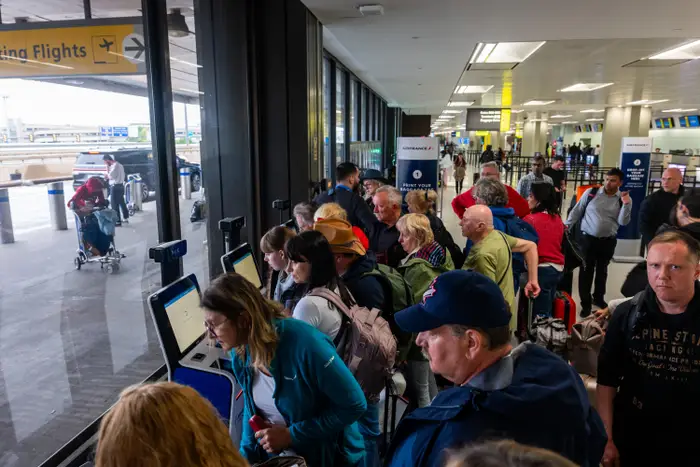
July 6, 2026 — If you have an international flight this month, you need to read this before you leave for the airport. International flight delays in July 2026 have reached extraordinary levels — driven by a perfect storm of three simultaneous forces: the FIFA World Cup 2026 knockout stage, the US America 250 celebrations, and a continent-wide wave of European labor strikes. The result is the most disrupted summer travel season in recent memory.
Here is a clear breakdown of what is happening, where, and what it means for your trip.
The Big Picture: Why Summer 2026 Is So Chaotic for Air Travel
Three major events have collided in the same travel window, pushing airports to their operational limits:
The FIFA World Cup 2026 is in its final weeks, with quarterfinals, semifinals, and the championship final on July 19 drawing millions of international fans to US host cities. The America 250 semiquincentennial triggered unprecedented airspace restrictions across the East Coast over the July 4 holiday weekend. And a coordinated wave of European labor strikes — spanning Italy, the UK, Spain, Portugal, and Belgium — is compounding congestion already worsened by the EU’s new biometric border system.
The numbers reflect the strain. On July 5 alone, US aviation recorded 182 cancellations and 693 delays nationwide. Today, July 6, that figure climbed to 529 cancellations and 3,263 delays across Chicago, New York, Boston, and Atlanta. In Europe, air travel across Europe was under heavy pressure on June 30, with 1,523 delays and 95 cancellations recorded in a single day at major hubs including London Heathrow, London Gatwick, Madrid Barajas, and Amsterdam Schiphol. AirHelp
⚽ FIFA World Cup 2026: The Airports Under Maximum Pressure Right Now
The World Cup’s final stage concentrates enormous passenger demand at a small number of US airports over the next two weeks. The United States hosts 78 matches in total, including all quarterfinals, semifinals, and the final, which will be played at MetLife Stadium in East Rutherford on July 19. Wikipedia
Four matches from July 9 to 11 decide the semifinalists, followed by two matches on July 14 and 15 to set the final. The two semifinal losers play for bronze in Miami Gardens, and the championship match takes place at MetLife Stadium in New Jersey. World Cup Wiki
The key airports to watch:
The two semi-finals are at AT&T Stadium in Dallas on July 14 and Mercedes-Benz Stadium in Atlanta on July 15. That puts Dallas/Fort Worth (DFW) and Hartsfield-Jackson Atlanta (ATL) at peak international inbound pressure on back-to-back days. Wego Travel Blog
The Third Place Match is on July 18 at Hard Rock Stadium in Miami Gardens. Miami International Airport (MIA) is the primary gateway — approximately 14–17 miles from Hard Rock Stadium, a 25–35 minute drive in normal traffic. Factor in World Cup crowds and MIA’s already elevated summer delay rate, and July 18 is a day to arrive early or build in significant buffer time. KickoffAdventures
The Final on July 19 converges all remaining traffic on the New York–New Jersey metro area. Travel professionals expect the combination of FIFA World Cup tourism and New York’s traditional summer attractions to generate exceptionally strong visitor numbers throughout the month. JFK, Newark (EWR), and LaGuardia (LGA) are all under sustained operational pressure heading into that weekend. Travel And Tour World
🔴 EES Biometric Border System: Up to 5-Hour Queues at European Airports
One of the most significant and least discussed drivers of international flight delays in summer 2026 is the EU’s Entry/Exit System (EES), which became fully operational in April and has created serious bottlenecks at Schengen area airports ever since.
According to the aviation industry letter to the European Commission, waiting times at border control are now reaching “up to five hours during peak traffic periods,” resulting in missed flights. With European airports expected to handle around 40 million more passengers during July and August than in the previous two months, industry organizations warned that conditions could deteriorate rapidly without further action. Euronews
Airlines and airports argue that since the full rollout of EES in April, waiting times for passengers entering the Schengen area have increased to as much as 5 hours during peak times, despite member states making extensive use of the temporary flexibility allowing border control authorities to suspend the collection of biometric data until the beginning of September. The industry is calling for member states to be given all the flexibility needed to completely suspend EES, preventively, whenever passenger volumes exceed the operational capacity of border control facilities. FlightGlobal
Ryanair’s chief operations officer put it bluntly: “Governments across Europe are attempting to roll out a half-baked IT system in the middle of the busiest travel season of the year, and passengers are paying the price, being forced to endure hours-long passport control queues and, in some cases, missing flights.” Biometric Update
Who is most affected: US, Canadian, UK, and Australian passport holders — all non-EU travelers — must complete biometric registration (fingerprints and facial scan) on their first entry. The airports with the worst EES-related queues this summer include London Heathrow, Gatwick, Paris CDG, Amsterdam Schiphol, Frankfurt, Madrid Barajas, Lisbon, Porto, and Faro.
Critical for your travel plans: Because these delays come from government border procedures rather than airline operations, compensation under EC 261 is unlikely if you miss a connection because of EES queues — the airline is generally not responsible for the border agency. Build at least 90 extra minutes into any Schengen connection and book morning or evening departures whenever possible. TravelPirates
🇮🇹 Italy Airport Strikes: The Worst Day Was July 5 — More Coming
Italy remained the single most disruptive country for European aviation this week. July 5 carried the highest disruption risk of the month for international travelers. Unlike rail or road strikes, aviation stoppages affect the primary entry point into the country and can collapse onward connections, car rentals, and hotel bookings in a single chain reaction. Dolce Via
The largest disruption involved ENAV air traffic control personnel assigned to Milan Malpensa’s airspace management center, beginning shortly after midnight and continuing for 24 hours. This is particularly important because aircraft traveling between Western Europe, Central Europe, and the Mediterranean frequently pass through northern Italian airspace regardless of whether they land in Italy. Airlines operating flights between destinations such as Spain, France, Germany, Greece, Croatia, Malta, and parts of Eastern Europe could experience delays caused by revised routing or air traffic restrictions. Travel And Tour World
Milan Malpensa experienced one of its most significant operational disruptions of the summer, with 81 flight cancellations and 19 delays affecting services across northern Italy’s busiest international gateway. Ryanair accounted for the highest number of cancellations with 27 cancelled flights, representing one-third of all cancellations at the airport. Travel And Tour World
The next confirmed Italian aviation disruption is scheduled for Milan Malpensa on July 21. Travelers with Italian itineraries in late July should monitor ENAC’s official strike calendar and their airline’s app closely.
🇬🇧 London Gatwick: Weekend Cancellations Disrupt US and European Routes
A total of 11 scheduled departures were cancelled over the weekend at London Gatwick Airport, affecting services to Marseille, Milan, Catania, Malaga, Ibiza, Barcelona, Lisbon, Marrakech, and Orlando, disrupting travel across Europe, North Africa, and the United States during one of the busiest periods of the summer travel season. The cancelled services involved multiple airlines, including easyJet, British Airways, Enter Air, and Vueling. Travel And Tour World
One of the most notable was the British Airways Boeing 777-200 service to Orlando International Airport, which was cancelled on Sunday morning — affecting passengers traveling to Florida for holidays, business, and onward domestic connections within the United States.
🇺🇸 US Airports: America 250 Fallout Still Being Felt
The Metropolitan Washington Airports Authority restricted all inbound and outbound flights starting at noon on Independence Day. DCA terminals operated at a “reduced capacity” until the airspace reopened. The cascading effects spread across the Eastern Seaboard and have continued into this week. The Hill
Ronald Reagan Washington National Airport experienced a major wave of operational disruptions involving a total of 29 flight cancellations, affecting both departures and airline schedules across a wide domestic and cross-border network, including Orlando, Boston, Chicago, Toronto, New York LaGuardia, New York JFK, and other key routes. Travel And Tour World
San Francisco International Airport experienced capacity constraints on July 4, with a combination of regional airspace congestion and downstream aircraft rotation issues leading to significant scheduling pressure. United Airlines recorded the highest number of delays with 111 flights. Nomad Lawyer
Miami International Airport has been particularly affected throughout the holiday stretch. A recent analysis by Air Advisor identified MIA as the US airport with the highest rate of delayed departures in early July, with historical data showing that over 60% of MIA flights were delayed on July 6 of last year.
😄 The Lighter Side of Summer Travel
The world’s longest flight is almost here. Qantas Airways has confirmed plans to launch a nonstop London–Sydney service — up to 22 hours in the air — as early as next year. Project Sunrise, the airline’s long-running ambition to connect the UK and Australia without a stop, is finally taking off. Airbus has already begun test flights of the Qantas A350 configured for the route.
Emirates goes gourmet. Passengers checking into Emirates lounges in Frankfurt and Munich are now the first to enjoy the airline’s new, reimagined spaces, featuring baristas, bartenders, and local dishes made fresh by an in-lounge chef. Next up: Manchester, Mauritius, and Istanbul. Upgraded Points
The TSA has jokes. Preparing to screen a record-breaking 18.7 million travelers over the July 4 holiday period, the TSA’s social team found time to remind travelers that barbecue sauce, guacamole, ranch dressing, and homemade potato salad all count as liquids under the 3.4-oz rule. Their caption on a jar of intercepted sauce: “We are b-ranching out.” The agency also recovered 64 hollow-point bullets hidden inside a strawberry drink mix container at Miami International Airport, noting: “This one might be hard to swallow.”
Not even the GOAT skips TSA. On July 2, a video of Lionel Messi and the entire Argentina squad going through a routine security check at Miami International Airport went viral with nearly 5 million views on X — and counting. The footage shows Messi waiting calmly on the tarmac before being scanned with a handheld metal detector and briefly patted down by security staff. He looked entirely unfazed — laughing with his teammates and clearly amused by the mundane reality of the security queue. Fans immediately saw the funny side, with one comment summing it up perfectly: “GOAT status doesn’t skip TSA.” The US has imposed stringent security screenings without exceptions for all World Cup delegations, including players, technical staff, and even family members — with several reportedly facing significant delays or questioning at entry. The internet’s verdict? The only defender who has ever truly stopped Messi.
The real MVP of the World Cup. Osito, a rescue dog in a Mexico national team jersey, became the tournament’s most viral personality after appearing at multiple matches in Mexico City. No ticket required.

 English
  Español
  Français
  简体中文
简体中文  Русский
  Italiano
  العربية