

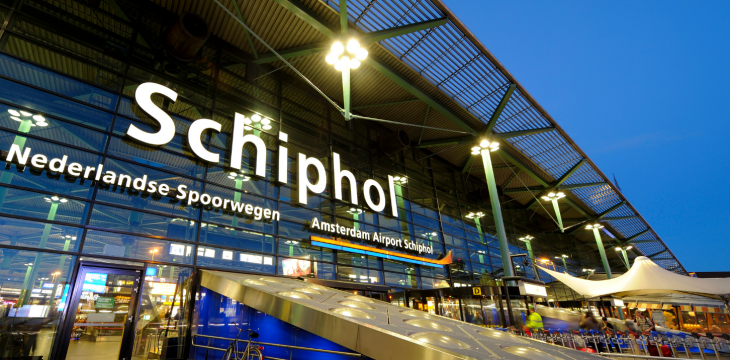
Amsterdam Schiphol Meet and Greet: What to Know Before You Land
Amsterdam Schiphol is one of the easiest large airports in Europe to describe and one of the easiest to underestimate. Everything sits under one roof, the train is under the terminal, and signage is in English everywhere. Then you land at 8 a.m. with three other long-haul flights, join the non-EU passport line, and the easy airport takes an hour to leave.
This guide explains how a Schiphol Meet and Greet works, what the airport actually looks like once you are inside, and what has changed at the border since the Entry/Exit System became mandatory in April 2026. It is written for travelers arriving from the United States, the Gulf, Asia and Latin America, and for the travel advisors who book on their behalf.
Schiphol in one paragraph
Schiphol handled 68.8 million passengers in 2025, which makes it the fourth busiest airport in Europe. It is the main hub for KLM and its partner airlines, and it sits about 9 kilometers southwest of central Amsterdam. Unlike London Heathrow or Paris Charles de Gaulle, Schiphol has a single terminal. There are no shuttle trains between buildings and no “wrong terminal” problem. What there is, instead, is distance. The terminal is built around a central hall called Schiphol Plaza, with three departure halls and seven piers (B through H, plus M) stretching out from it. Some of those piers are a long walk from the center.
Amsterdam Schiphol Meet and Greet: Departure halls, piers, and where the border is
The layout matters because it decides which lines you will stand in.
Departure Hall 1 serves Piers B and C, which handle Schengen flights. Departure Hall 2 serves Piers D and E. Pier D is the largest at the airport and works on two levels: one for Schengen and one for non-Schengen flights. Pier E is used mostly by KLM and SkyTeam partners for non-Schengen routes. Departure Hall 3 serves Piers F, G and the combined H/M area, where many low-cost carriers depart.
For a traveler from outside the EU, the practical rule is this: Piers E, F, G and H are the non-Schengen side, which means passport control sits between you and the rest of the airport. Piers B, C and M are Schengen, so there is no passport check if you are continuing to another Schengen country. Pier D can be either depending on the level you are on.
Arrivals work the same way in reverse. If you land from a non-Schengen country, you clear passport control before baggage reclaim. If you land from a Schengen country, you walk straight to the baggage hall.
The border is where the time goes
Since 10 April 2026, all non-EU travelers entering the Schengen area for a short stay must register in the European Entry/Exit System. At Schiphol, that means your passport is scanned, a photo is taken and your fingerprints are recorded at a kiosk or a border desk on your first entry. The registration stays valid for up to three years or until your passport expires, so the first trip after April 2026 is the slow one and later trips are shorter.
Schiphol itself has been direct about what this means for arriving passengers. In its summer 2026 arrivals notice the airport says passport control “may be busier upon arrival” during holiday periods, because several long-haul flights land at the same time and every non-EU passenger on them now has to be registered. Its advice is simple and worth following: join the queue that matches your passport, use the eGates if you are over 14, and accept it when staff suggest walking to a quieter checkpoint.
EU and Dutch passport holders are not affected. Non-EU passport holders with permanent residency in the EU are exempt as well.
Connections and the transfer filter
Two connection patterns behave very differently at Schiphol.
If you arrive from outside Schengen and continue to another non-Schengen destination, you usually stay airside and do not pass the border at all. If you arrive from outside Schengen and continue to a Schengen destination (Amsterdam to Madrid, for example), you cross the border at a transfer passport control rather than at arrivals. That is the connection where EES registration happens on the way to your next gate, and it is the one that catches people with a tight layover.
KLM’s published minimum connecting times at Schiphol are 40 minutes for Schengen to Schengen and 50 minutes for connections involving a non-Schengen flight. Those are minimums, not recommendations. On a morning bank of arrivals in summer, they are not enough for a non-EU passenger who still has to register.
What a Schiphol Meet and Greet actually includes
This is the part where it helps to be precise, because Schiphol is not an airport where anyone can promise you a private lane. Even the airport’s own Meet & Assist operation states plainly that it does not sell priority or guaranteed speed, and that waiting times at security and passport control are outside its control because these are official border checks.
So what does a greeter do? Quite a lot, as it turns out.
On arrival, your greeter waits at the aircraft door or the arrival gate. They walk with you to the correct passport control area, stay with you while you wait, help you at the EES kiosk, take you to the right baggage belt and arrange porter help for your bags, and bring you through customs to the arrivals hall, your driver or the train station under the terminal. If you have a connection, they take you to the transfer passport control instead and on to your next gate.
On departure, the greeter meets you outside or inside the departure hall two hours before your flight. They handle the check-in process with you, walk you through security and passport control, and either take you to your lounge or directly to the gate. At Schiphol the service is timed at two hours for a reason: the airport’s own hosts say a two-hour window is “amply sufficient” to reach the gate on time, and they do not start earlier than that.
On a connection, the greeter meets you at the aircraft door, works out the fastest route to your next pier based on your passport and destination, and stays with you until boarding. This is the scenario where the service is most valuable, because it removes the most common Schiphol mistake: standing in the wrong queue with a boarding time approaching.
What you are buying at Schiphol is not a shortcut. It is someone who knows the building, walks you through it, makes sure your paperwork is ready before you reach the desk, and carries your bags while you deal with the rest.
Practical details that matter at AMS
Booking lead time. Schiphol’s greeter capacity is limited and hosts are assigned per day. In practice this means booking early. During Dutch school holidays and the summer peak, dates fill up. A booking made a few days before travel may not be possible, and a greeter is confirmed only once one is assigned.
Meeting point details arrive close to the date. At Schiphol the name of your host and the exact meeting point are sent a few days before travel rather than at the time of booking. This is normal and not a sign that something is wrong.
Which time to give. When you book, provide your scheduled flight arrival or departure time, not the time you would like to meet the greeter. The meeting time is calculated from the flight.
Porters and bags. Porter service at Schiphol is priced per set of bags and can be added to any Meet and Greet. Luggage carts in the terminal are free, but a porter means you are not pushing one through passport control with a child on your hip.
Lounges. Lounge access is available with the higher service tier and depends on your departure pier and time. Your greeter can take you to the lounge and collect you before boarding.
Wheelchair assistance is a separate airline service. If you need it, request it directly from your airline when you book your flight. A greeter can walk beside you, but cannot replace airline mobility assistance.
Getting into the city. The train station is directly under Schiphol Plaza and trains to Amsterdam Centraal take around 15 minutes. If you have a driver, your greeter hands you over in the arrivals hall.
Six things that make a Schiphol arrival easier
- Land in the evening if your schedule allows. The morning bank of long-haul arrivals is when passport control is busiest.
- Have your passport out and ready before the kiosk. EES registration is quick when the document is in hand and slow when it is at the bottom of a bag.
- If you are connecting from a non-Schengen flight to a Schengen one, treat the airline’s minimum connecting time as a floor and add margin.
- Book your greeter as soon as your flights are ticketed, especially for July, August and the Dutch autumn and Christmas holidays.
- Give the exact flight times when booking, and update them if the airline changes the schedule.
- Request wheelchair or medical assistance from your airline separately. It is not part of any airport greeter service.
Frequently asked questions about Schiphol Meet and Greet
Does a Schiphol Meet and Greet include fast track? No. Schiphol does not offer a dedicated fast track lane for third-party greeter services, and passport control is an official border check whose timing nobody can guarantee. Your greeter escorts you through the terminal, helps at every checkpoint and stays with you while you wait.
Where does the greeter meet me on arrival? At the door of the aircraft or directly at the arrival gate, then through passport control, baggage reclaim and customs to the arrivals hall or your connecting gate.
How early does the greeter meet me for a departure? Two hours before the scheduled departure time. At Schiphol the service does not start three or four hours ahead; two hours is the standard window and it is enough to reach the gate comfortably.
When will I receive the meeting point and the greeter’s name? Shortly before the travel date, typically a few days ahead. The booking itself is confirmed only once a greeter has been assigned to your date.
Do I need to do anything for EES before I arrive? No pre-registration is possible. Registration happens at the border on your first entry after 10 April 2026 and stays valid for up to three years. Have your passport ready and follow the signs for non-EU passengers.
Can I book a greeter at short notice? Sometimes, but availability at Schiphol is limited and depends on host capacity for that day. Short-notice requests are checked individually and are only confirmed once a greeter is assigned, so book as early as you can.
Does the greeter help with a connection? Yes. The greeter meets you at the aircraft door and takes you to the correct transfer passport control or directly to your next pier, depending on where you are flying from and to.
Planning a trip through Amsterdam? See what a Meet and Greet at Schiphol looks like for your arrival, departure or connection on our AMS airport service page.

 Español
 English
 Français
 简体中文
 Русский
 Italiano
 العربية